A generic object factory. More...
#include <GenericFactory.hpp>
Public Types | |
| using | AbstractProduct_type = AbstractProduct |
| The container for the rules. | |
| using | Identifier_type = Identifier |
| The identifier. | |
| using | Builder_type = Builder |
| The builder type. | |
| using | Container_type = std::unordered_map< Identifier, Builder_type > |
| Method to access the only instance of the factory. | |
Public Member Functions | |
| template<typename... Args> | |
| std::unique_ptr< AbstractProduct > | create (Identifier const &name, Args &&...args) const |
| Get the rule with given name . | |
| Builder | get (Identifier const &name) const |
| void | add (Identifier const &, Builder_type const &) |
| Register the given rule. | |
| std::vector< Identifier > | registered () const |
| Returns a list of registered rules. | |
| void | unregister (Identifier const &name) |
| Unregister a rule. | |
| void | clear () |
| clear the factory | |
| bool | empty () const |
| Test if factory has some items registered. | |
| Container_type const & | getStorage () const |
| Factory (Factory const &)=delete | |
| Deleted since it is a Singleton. | |
| Factory & | operator= (Factory const &)=delete |
| Deleted since it is a Singleton. | |
Static Public Member Functions | |
| static Factory & | Instance () |
Private Member Functions | |
| Factory ()=default | |
| Made private since it is a Singleton. | |
Private Attributes | |
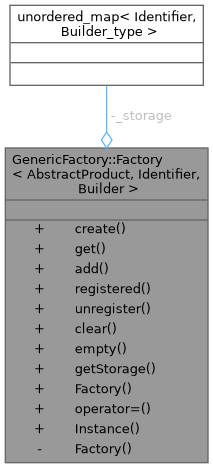
| Container_type | _storage |
| It contains the actual object factory. | |
Detailed Description
class GenericFactory::Factory< AbstractProduct, Identifier, Builder >
A generic object factory.
Freely inspired from the Alexandrescu Book.
It is implemented as a Singleton. The compulsory way to access a method is Factory::Instance().method(). Typically to access the factory one does
- Template Parameters
-
AbstractProduct The type of the base abstract class whose object are produced by the factory Identifier The identifier used to select the concrete object produced by the factory. It must have an ordering relation since they will be stored as key in a std::map Builder The type of the callable object that produces the the concrete object derived from AbstractProduct It may have arguments but its return type must be std::unique_ptr<AbstractProduct>.
- Exceptions
-
An astralog::RuleError if something goes wrong when querying the factory (unknown or doubly-registered identifier).
- Note
- The Identifier should have a output stream operator for the construction of the exception.
Member Typedef Documentation
◆ AbstractProduct_type
| using GenericFactory::Factory< AbstractProduct, Identifier, Builder >::AbstractProduct_type = AbstractProduct |
The container for the rules.
◆ Builder_type
| using GenericFactory::Factory< AbstractProduct, Identifier, Builder >::Builder_type = Builder |
The builder type.
The default is a function wrapper that returns a unique_ptr<AbstractProduct> and with no arguments.
◆ Container_type
| using GenericFactory::Factory< AbstractProduct, Identifier, Builder >::Container_type = std::unordered_map<Identifier, Builder_type> |
Method to access the only instance of the factory.
◆ Identifier_type
| using GenericFactory::Factory< AbstractProduct, Identifier, Builder >::Identifier_type = Identifier |
The identifier.
It is used to identify the rules.
Constructor & Destructor Documentation
◆ Factory() [1/2]
|
delete |
Deleted since it is a Singleton.
◆ Factory() [2/2]
|
privatedefault |
Made private since it is a Singleton.
Member Function Documentation
◆ add()
| void GenericFactory::Factory< AbstractProduct, Identifier, Builder >::add | ( | Identifier const & | name, |
| Builder_type const & | func | ||
| ) |
Register the given rule.
◆ clear()
|
inline |
clear the factory
◆ create()
| std::unique_ptr< AbstractProduct > GenericFactory::Factory< AbstractProduct, Identifier, Builder >::create | ( | Identifier const & | name, |
| Args &&... | args | ||
| ) | const |
Get the rule with given name .
The pointer is null if no rule is present.
- Template Parameters
-
Args Automatically deduced parameter pack, it is the list of types of the builder arguments. It may be empty.
- Parameters
-
name The identifier args The arguments pack to be passed to the builder. It may be empty
- Note
- The default builder does not take any argument. This version is provided in case the template is specialized with a builder that takes arguments. The method is disabled if AbstractProduct is void
◆ empty()
|
inline |
Test if factory has some items registered.
◆ get()
| Builder GenericFactory::Factory< AbstractProduct, Identifier, Builder >::get | ( | Identifier const & | name | ) | const |
Returns the builder
◆ getStorage()
|
inline |
◆ Instance()
|
static |

◆ operator=()
|
delete |
Deleted since it is a Singleton.
◆ registered()
| std::vector< Identifier > GenericFactory::Factory< AbstractProduct, Identifier, Builder >::registered | ( | ) | const |
Returns a list of registered rules.
◆ unregister()
|
inline |
Unregister a rule.
Member Data Documentation
◆ _storage
|
private |
It contains the actual object factory.
The documentation for this class was generated from the following file:
- include/RulesFactory/GenericFactory.hpp