SSH/SCP connection to a single remote host via the system ssh/scp.
More...
#include <JobScheduler.hpp>
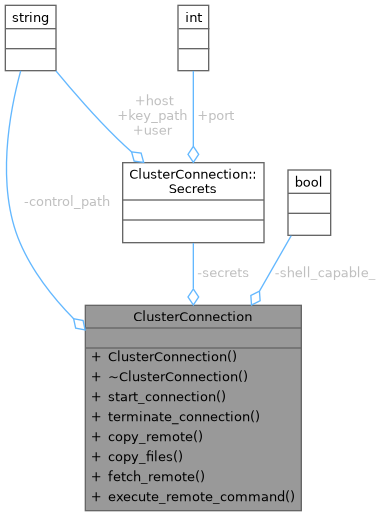
Classes | |
| struct | Secrets |
| SSH credentials; never exposed outside this class. More... | |
Public Member Functions | |
| ClusterConnection (std::string host, std::string user, std::string key_path, int port=22, bool shell_capable=true) | |
| Stores connection parameters; opens no connection. | |
| ~ClusterConnection () | |
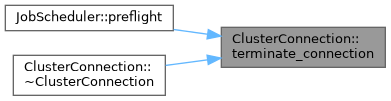
Closes the multiplexed master via terminate_connection(). | |
| bool | start_connection () |
| Opens (and pins) the multiplexed SSH master with a no-op command. | |
| bool | terminate_connection () |
Tears down the multiplexed master via ssh -O exit (best effort). | |
| bool | copy_remote (const std::string &local_filepath, const std::string &remote_dir, const std::string &remote_name="") |
| Uploads a local file to a remote directory via SCP. | |
| bool | copy_files (const std::vector< std::string > &local_filepaths, const std::string &remote_dir) |
| Uploads several local files to a remote directory in one SCP session. | |
| bool | fetch_remote (const std::string &remote_filepath, const std::string &local_dir) |
| Downloads a single remote file into a local directory via SCP. | |
| std::string | execute_remote_command (const std::string &command) |
| Executes a shell command on the remote host and returns its stdout. | |
Private Attributes | |
| Secrets | secrets |
| std::string | control_path |
-o ControlPath= socket template for multiplexing. | |
| bool | shell_capable_ |
| False for transfer-only hosts (data-mover). | |
Detailed Description
SSH/SCP connection to a single remote host via the system ssh/scp.
Auth uses the operator's SSH certificate already in place (ssh-agent, or a key file whose matching *-cert.pub ssh picks up). Host keys are verified against CLUSTER_KNOWN_HOSTS; host-key checking is never disabled.
Lifecycle: construct, start_connection() (opens a multiplexed ControlMaster, retrying CINECA's flaky handshakes), then copy_remote() / fetch_remote() / execute_remote_command() reuse that socket, then terminate_connection() (the destructor also does it).
- Note
- Not copyable; holds the per-host
ControlPathsocket template.
Constructor & Destructor Documentation
◆ ClusterConnection()
| ClusterConnection::ClusterConnection | ( | std::string | host, |
| std::string | user, | ||
| std::string | key_path, | ||
| int | port = 22, |
||
| bool | shell_capable = true |
||
| ) |
Stores connection parameters; opens no connection.
- Parameters
-
host Hostname or IP of the remote node. user SSH username. key_path Path passed to ssh -i; empty to rely on the ssh-agent.port TCP port (default 22). shell_capable falsefor hosts that reject shell commands (e.g. the CINECA data-mover): start/terminate become no-ops and SCP runs without ControlMaster, so no shell session is opened.
◆ ~ClusterConnection()
| ClusterConnection::~ClusterConnection | ( | ) |

Member Function Documentation
◆ copy_files()
| bool ClusterConnection::copy_files | ( | const std::vector< std::string > & | local_filepaths, |
| const std::string & | remote_dir | ||
| ) |
Uploads several local files to a remote directory in one SCP session.
Equivalent to calling copy_remote() once per file, but issues a single scp f1 f2 ... user@host:remote_dir/ so only one connection (and, for the data-mover, one handshake) is paid for the whole set. Each file keeps its basename on the remote — callers needing a rename must stage the file under the desired name locally first.
- Parameters
-
local_filepaths Paths to upload; all must exist or the call fails. remote_dir Absolute destination directory on the remote host.
- Returns
trueif every file transferred successfully.

◆ copy_remote()
| bool ClusterConnection::copy_remote | ( | const std::string & | local_filepath, |
| const std::string & | remote_dir, | ||
| const std::string & | remote_name = "" |
||
| ) |
Uploads a local file to a remote directory via SCP.
- Parameters
-
local_filepath Absolute or relative path to the source file. remote_dir Absolute path of the destination directory on the remote. Must be an absolute path — env vars such as $SCRATCHare not expanded on the data-mover node.remote_name If non-empty, the file is stored under this name instead of the original filename. Used to avoid concurrent-job collisions for batch files.
- Returns
trueon success.
◆ execute_remote_command()
| std::string ClusterConnection::execute_remote_command | ( | const std::string & | command | ) |
Executes a shell command on the remote host and returns its stdout.
- Parameters
-
command The command string run via the system sshbinary over a multiplexed master connection.
- Returns
- The captured stdout, or an empty string if the channel could not be opened or the exec failed.
- Warning
- SECURITY:
commandmust be built from compile-time constants or env-var secrets set at startup — never from incoming data (e.g. MQTT payloads).

◆ fetch_remote()
| bool ClusterConnection::fetch_remote | ( | const std::string & | remote_filepath, |
| const std::string & | local_dir | ||
| ) |
Downloads a single remote file into a local directory via SCP.
- Parameters
-
remote_filepath Absolute path to the file on the remote host. local_dir Local directory where the file will be written (filename is preserved from the remote path).
- Returns
trueif the file was downloaded, or if it simply does not exist on the remote (a benign "nothing to fetch" — logged once, not retried);falseonly on a transport error (retried within the budget first).

◆ start_connection()
| bool ClusterConnection::start_connection | ( | ) |
Opens (and pins) the multiplexed SSH master with a no-op command.
Retries with backoff to absorb CINECA's flaky handshakes. Once it succeeds, later transfers/commands reuse the master socket.
- Returns
trueif the master could be established within the retry budget; otherwisefalsewith a diagnostic onstd::clog.

◆ terminate_connection()
| bool ClusterConnection::terminate_connection | ( | ) |
Tears down the multiplexed master via ssh -O exit (best effort).
Safe to call multiple times; failures are ignored.
- Returns
- Always
true.
Member Data Documentation
◆ control_path
|
private |
-o ControlPath= socket template for multiplexing.
◆ secrets
|
private |
◆ shell_capable_
|
private |
False for transfer-only hosts (data-mover).
The documentation for this class was generated from the following files:
- include/Collector/JobScheduler.hpp
- src/Collector/JobScheduler.cpp